
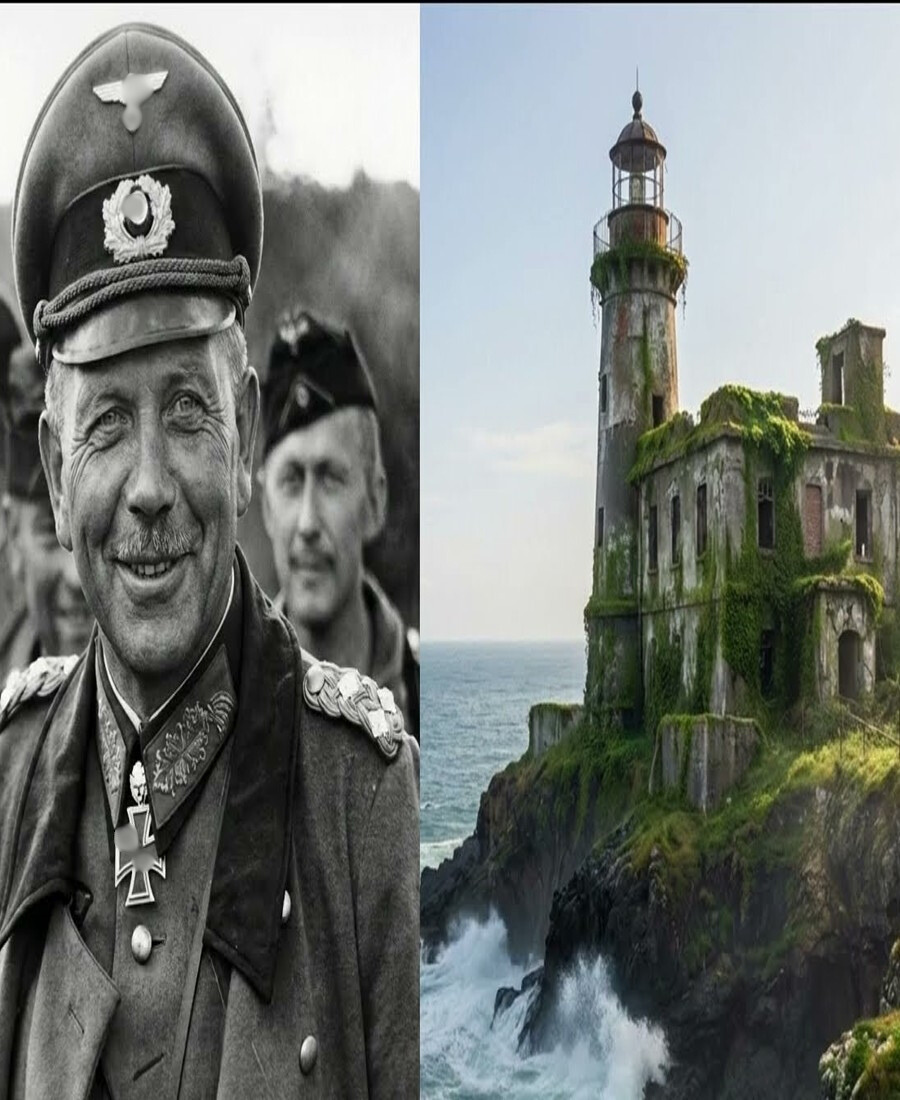
Wehrmacht General Disappeared in 1945 — 79 Years Later, a Hidden Fortress Beneath a Lighthouse Was Discovered
In September 2024, while mapping coastal erosion along a remote stretch of the Black Sea, a drone operator noticed an unusual thermal signature. Heat appeared to be coming from inside an abandoned lighthouse that had not functioned since 1944. Three weeks later, when a local archaeological team managed to open its rusted metal door, they found something unexpected: a staircase leading down into the ground rather than up to the lantern room.
Below the structure was a large underground bunker complex that had never appeared in any official records. In the third chamber, researchers found a German officer's cap, a half-finished bottle of liquor, and a handwritten list of names. The final entry was dated May 17, 1945, nine days after Germany's surrender.
That lighthouse had concealed a secret for 79 years.
By following the signature on that list, investigators were drawn into one of the most unusual stories connected to the final phase of the Second World War. In the spring of 1945, as the Third Reich collapsed, many senior German officers were no longer thinking about victory. They were thinking about survival. In that context, the name of Lieutenant General Wilhelm Forester emerged.
Forester commanded the 19th Security Division, a unit responsible for coastal defense infrastructure along the Black Sea from 1943 to early 1945. Before the war, he had been a civil engineer specializing in fortification design. He was known as a careful and highly methodical officer with an unusual focus on contingency planning. At 52, he was not a battlefield commander in the traditional sense, but he held an important advantage: access to construction materials, civilian labor, and detailed knowledge of defensive sites across a wide coastal region.
From August 1943 to January 1945, official records show that his division built or reinforced 47 installations. Yet the evidence suggests there was a forty-eighth site, one that never appeared in the paperwork.
By March 1945, Germany's strategic position had become hopeless. Soviet forces were pushing toward Berlin, while German units in the Balkans were being isolated. Forester received orders to withdraw westward. Officially, he complied. But during that same week, he and a group of eight selected men disappeared from the record.
The location later uncovered was a lighthouse on a promontory about 40 kilometers south of Constanța, Romania. Built in 1909, the structure had been damaged by Soviet naval fire in 1944 and was later marked as destroyed on German charts. Its ruined appearance made it the ideal cover.
Between October 1944 and March 1945, Forester is believed to have quietly redirected cement, steel reinforcement, diesel generators, and other materials to the site. He used rotating labor teams so that no one group understood the full scale of the project. The bunker was excavated deep into the rock beneath the lighthouse, with reinforced concrete walls, concealed ventilation shafts, and a freshwater reservoir cut into the natural stone. Once sealed, it was designed to remain almost invisible from the surface.
According to documents later found inside, Forester was not simply preparing a temporary refuge. He appears to have envisioned a long-term survival plan for the period after the war. On the night of March 17, 1945, in a damaged church about 15 kilometers from the lighthouse, he assembled eight men: two civil engineers, three infantry sergeants, a medic or radio specialist, and his close aide, Hermann Franz Richter.
He did not tell them they were deserting. Instead, he described the mission as a classified operation intended to support a future regrouping of German forces in the Balkans. Richter appears to have been the only one who knew the full truth. The group traveled in three civilian vehicles over two nights and entered the bunker before dawn on March 19 through a concealed shaft hidden within the lighthouse ruins.
The first weeks underground were tightly controlled. Forester maintained discipline, assigned watches, and kept detailed supply logs. They had enough food for several months if rationed carefully. The generator was used only a few hours each evening to conserve fuel. Through the radio, they followed the collapse of Germany: the assault on Berlin, the report of Hitler's death, and the unconditional surrender on May 7, 1945.
From that point, the plan began to fail. Some of the men wanted to leave and surrender immediately, believing there was no purpose in remaining hidden after the war had ended. Forester refused. He argued that they should wait at least a year, allow conditions to stabilize, and then attempt to leave Europe through contacts and routes he believed he could access. He had also stored money and gold as part of that plan.
On May 17, 1945, the tension turned violent. According to forensic evidence and the journal later recovered, an argument during the evening meal escalated into gunfire. Within a very short time, four men were dead. The survivors moved the bodies to the lowest level and sealed them in a former storage room.
That same night, Forester wrote the list later found on his desk. It contained 34 names organized into several categories: officers with access to funds, possible helpers in neutral countries, and, most significantly, several other coastal bunker sites prepared as fallback locations. The document suggests that Forester may have been connected to an informal network intended to create hiding places and escape infrastructure for some German officers in the final stage of the war.
After 1945, almost no one actively searched for him. In the confusion of the postwar period, thousands of German officers were missing. His name did not appear prominently on wanted lists, and his family was informed only that he was presumed dead or missing. His wife died in 1959 without knowing what had actually happened.
The lighthouse was then abandoned. During the Cold War, this part of the Black Sea coast became heavily militarized, and many former German sites were either neglected, restricted, or forgotten. No one had reason to suspect that beneath the ruined foundation lay a carefully built underground complex.
Only in 2024, during a coastal erosion survey using thermal imaging and ground-penetrating radar, did the site draw attention again. Doctoral student Elena Constantinescu identified an abnormal heat pattern beneath the old foundation. Repeated drone passes confirmed the anomaly. Archaeologists, structural engineers, and military historians then conducted a field investigation, and radar data revealed multiple underground voids extending deep into the bedrock.
Excavation began in late October 2024. When the concrete seal over the entrance was opened, the team found a steel staircase descending into a multi-level bunker. Inside were military items, maps, a desk, radio equipment, and human remains in deteriorated German uniforms.
The recovery operation lasted several weeks. The bunker had four main levels. The first contained the command post with Forester's desk and documents. In the living quarters, forensic specialists identified signs of a close-range gunfight, consistent with the journal account. Another level held food supplies, medical material, and the remains of the power system. The lowest level contained additional remains, including those identified as Wilhelm Forester.
Next to him were a pistol, personal papers, family photographs, an unsent letter to his wife, and a 73-page handwritten journal. The journal, dated from March 19 to early September 1945, was authenticated as Forester's writing. It shows that after the shooting in May, the group's situation steadily deteriorated. Fuel ran low, food supplies declined, wounds and illness worsened, and trust among the survivors largely disappeared.
The final entries reflect severe physical and mental exhaustion. Forester wrote of plans to leave the bunker, adopt a false identity, and attempt escape through the Balkans. Yet he appears never to have carried that out. His remains were found only a short distance from the exit.
Even more significant was the list of 34 names he left behind. When investigators compared it with postwar records, they found that several individuals on the list had indeed disappeared or later surfaced in South America. Some of the coordinates in the document also led to other coastal shelter sites in Romania and Bulgaria, indicating that a loose network of fallback positions may have existed.
One of the most moving discoveries was the unsent letter to his wife. In it, Forester admitted his error, referred to the decision to hide, described the shooting, and asked for forgiveness. He wrote that he had hoped to survive the chaos and eventually return home, but had come to understand that he was trapped by the consequences of his own decision.
In December 2024, the Romanian Institute of Archaeology held a small memorial ceremony at the site. The remains of the nine men were returned to their families when relatives could be located. The lighthouse is now protected as a historical site, while the bunker remains reserved for research purposes.
What makes this story compelling is not only the scale of the hidden structure or the sophistication of the escape plan. It is also a reminder of human limits under extreme pressure. Forester was a capable engineer and an organized officer who had built effective defensive works. Yet he misjudged the effect of fear, isolation, and psychological strain inside a sealed space.
Concrete walls may be built to resist war, but they cannot shield people from the consequences of the choices they carry inside with them. After nearly eight decades, the secret beneath the lighthouse has finally come to light. Not to celebrate it, and not to reduce it to a simple moral judgment, but to preserve a complex story about war, choice, and truth buried for far too long.